
Crypto casino review
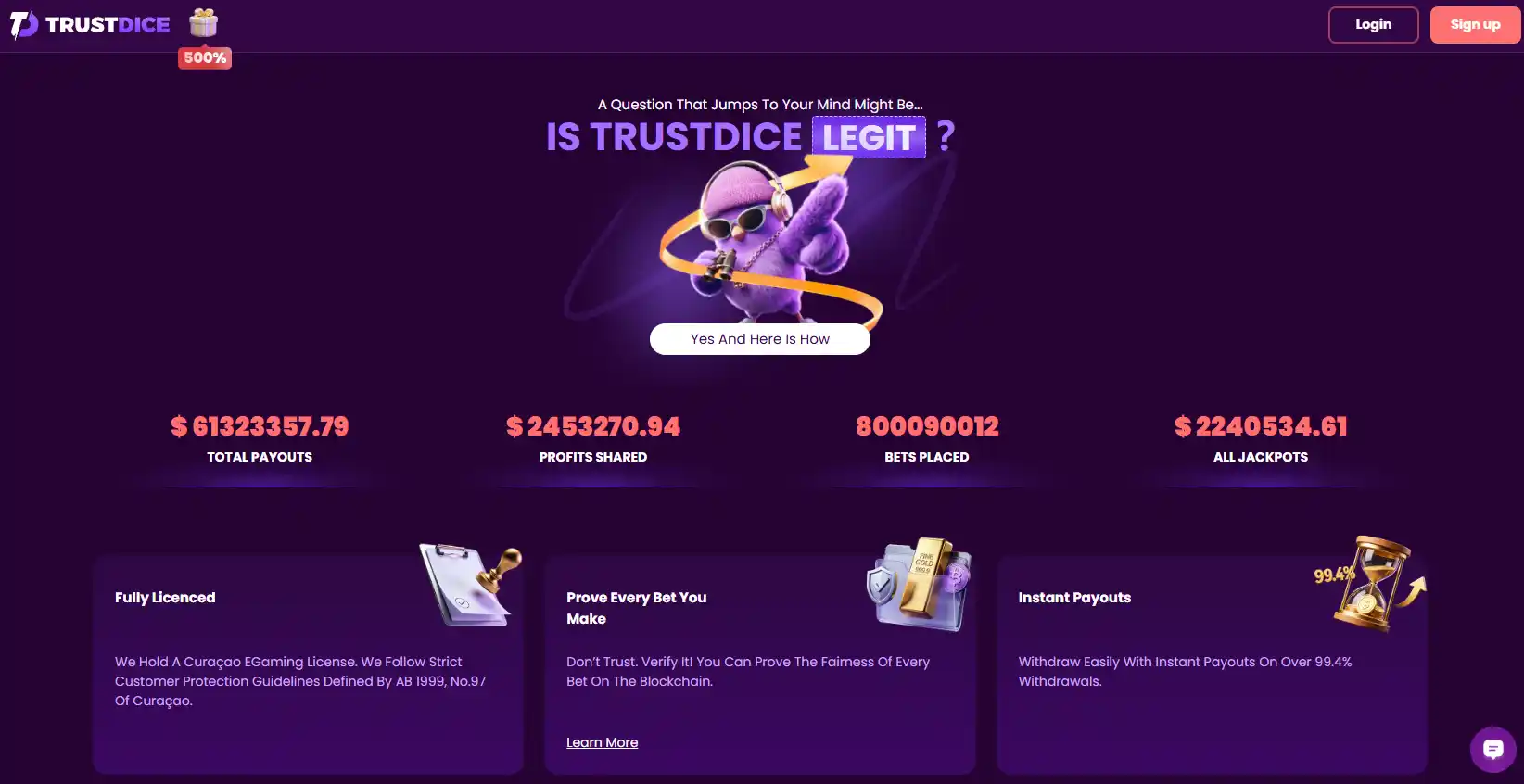
TrustDice has operated since 2018 as a crypto-native gambling platform with a strong Bitcoin-dice and EOS heritage. Its casino combines a large third-party catalogue with live tables, first-party provably fair games, multi-chain payments and a reward system built around its TXT token. The useful question is not whether the feature list is long, but how those parts affect deposits, wagering, game verification and withdrawals.
TrustDice also includes a sportsbook alongside the casino.
TrustDice at a glance
The casino is unusually crypto-specific rather than a conventional casino with Bitcoin added as one payment option. That shows up in the supported assets, the EOS-based TXT token and the first-party games whose outcomes can be checked on-chain.
- Operating since2018
- Supported crypto assetsBTC, ETH, TRX, EOS, BNB, XRP, USDT, USDC, LTC, DOGE
- Welcome package ceilingUp to 3 BTC across the first three deposits
- Working wagering figure40×
- First-party gamesDice, Crash, Plinko, Wheel and more
- Mobile accessBrowser-based on iOS and Android
- 2018established
- 10listed crypto assets
- 3 BTCwelcome package ceiling across three deposits
Payments are a network choice as well as a coin choice
TrustDice works across Bitcoin, Ethereum/ERC20, TRON/TRX, EOS, BEP20/BNB and XRPL rails. For a user, selecting the right asset is only half the job: the receiving network must also match the sending wallet. A correct coin sent on an unsupported route can be difficult or impossible to recover.
The casino mixes provider games with native originals
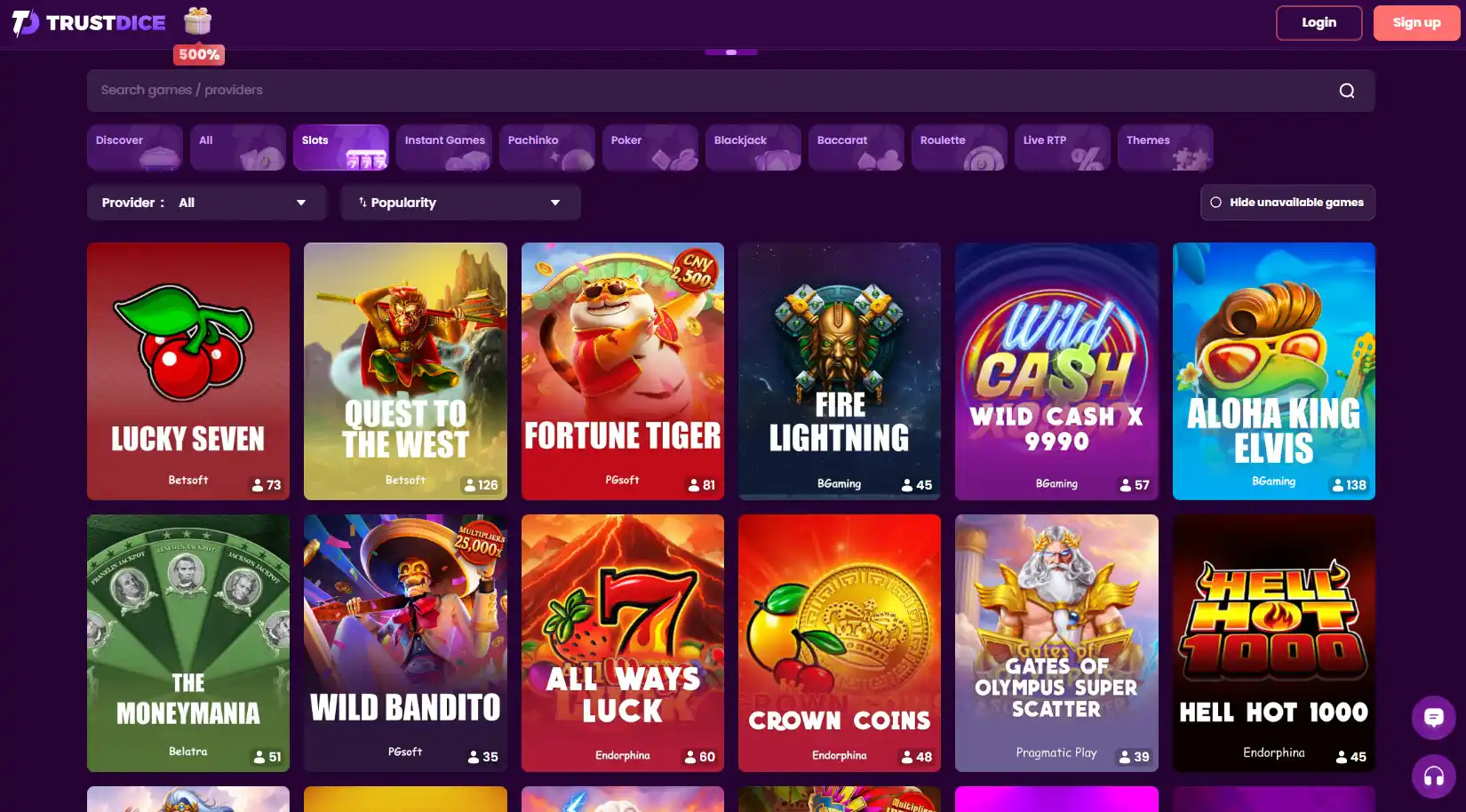
Pragmatic Play, Evolution, BGaming, NetEnt, Endorphina, PG Soft, Onlyplay, Betsoft, Ezugi, Play’n GO, Habanero, GameArt, Booming Games, Spinomenal and Belatra are among the named studios. TrustDice originals add a different layer because their game events are designed for on-chain verification.
Rewards extend beyond a single welcome offer
TXT can be mined through play and staked for daily dividends in BTC, ETH, EOS, USDT and USDC. A faucet and VIP/rakeback system sit alongside that token economy. These mechanics should be treated as separate reward systems, because each creates different conditions and exposure.
The clearest way to evaluate TrustDice is to separate four jobs: move crypto correctly, understand turnover before taking a bonus, distinguish third-party games from verifiable originals, and treat reward tokens as casino mechanics rather than an expected-return product.
Crypto payments across several networks add flexibility and more room for mistakes
TrustDice lists ten crypto assets: BTC, ETH, TRX, EOS, BNB, XRP, USDT, USDC, LTC and DOGE. Its payment setup is multi-chain, covering Bitcoin, Ethereum/ERC20, TRON/TRX, EOS, BEP20/BNB and XRPL, while the stablecoins can use more than one network. That breadth is useful when you already hold crypto, but it makes the deposit screen a critical checkpoint rather than a formality.
The minimum deposit should be read from the current payment dialog because published figures differ by asset and network. That is typical of crypto rails: a threshold that makes sense for one token can be inappropriate for another, and the network selected for a stablecoin can alter both transfer cost and settlement behavior. The dedicated TrustDice payments guide maps the supported coins, network information and cashout friction in more detail.
On withdrawals, TrustDice does not add its own withdrawal fee; the user still pays the blockchain network fee. This distinction matters. A zero casino fee does not mean a zero-cost transfer, because miners or validators still need to process the transaction. During busy periods, the network portion can become the dominant cost, especially for smaller withdrawals.
Casino withdrawal fee
No TrustDice withdrawal fee; blockchain network fees still apply.
Deposit threshold
Depends on the asset and network shown in the payment dialog.
Withdrawal threshold
Roughly 20–30 USDT-equivalent depending on the asset.
Withdrawal timing
The site promotes instant crypto payouts, while independent reports describe cases ranging from under an hour to as long as about 48 hours, with checks capable of extending the process.
- Choose the asset in the casino payment dialog and note the exact receiving network.
- Match that network in your sending wallet or exchange before copying the address.
- Check the current minimum and network fee rather than relying on a generic crypto threshold.
- For a withdrawal, leave room for any identity review and for the blockchain confirmation process.
Crypto transfers are generally irreversible. A wrong address or mismatched network can turn a routine deposit into a recovery problem, so the asset, network and destination should be checked together before sending.
A broad catalogue combines conventional providers with TrustDice originals
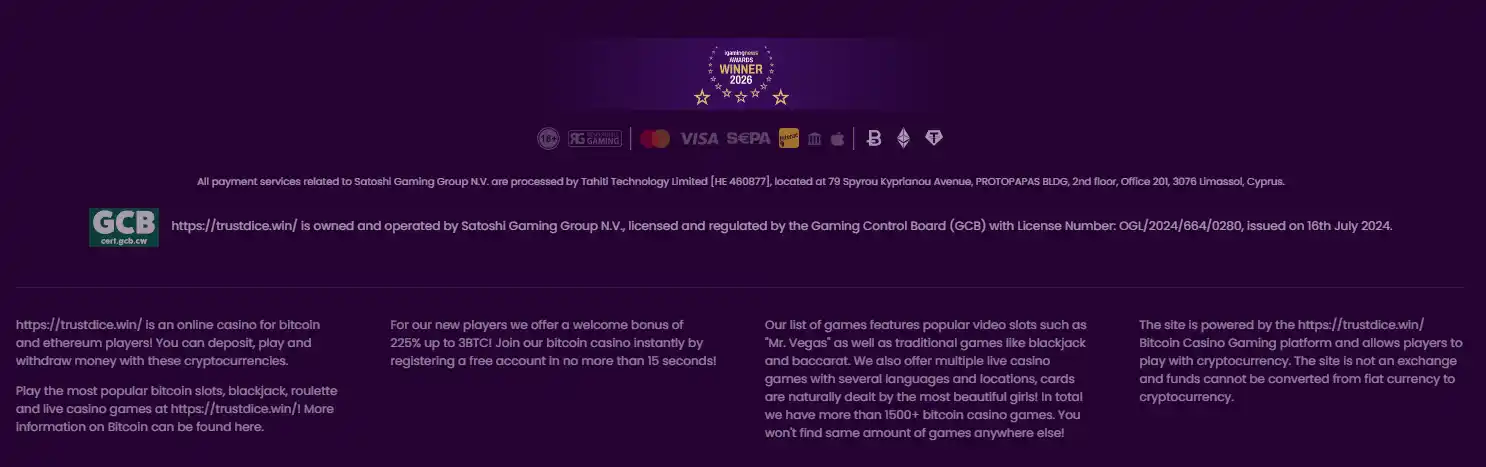
Published catalogue figures now sit in the thousands: newer counts start at 8,000+ games and some reach 10,000+. The exact total moves and is not consistent enough to reduce to one fixed number. The more useful distinction is structural. TrustDice carries third-party slots and table games, live-dealer content from Evolution and Ezugi, and its own Dice, Crash, Plinko and Wheel titles.
The provider side gives familiar casino variety. The originals side is where TrustDice is more distinctive, because the platform’s native provably fair system is built around on-chain verification. The TrustDice games section separates those categories and routes into the dedicated originals and fairness guides.
Where the catalogue is strongest
- Recognizable third-party studios across slots and casino games.
- Live tables from Evolution and Ezugi.
- First-party Dice, Crash, Plinko and Wheel games.
- Native originals that can be checked on-chain.
What a large catalogue does not tell you
- A game count does not reveal the RTP of an individual title.
- Provably fair verification applies to the mechanism that exposes verifiable data; it does not automatically turn every provider title into an on-chain game.
- Do not attach a house-edge assumption to TrustDice originals unless the specific game states an RTP or house edge.
On-chain verification can test game integrity without promising a profitable outcome
TrustDice’s native provably fair technology is one of the strongest reasons to treat its originals differently from a conventional game lobby. Dice, Crash, Plinko and Wheel are described as having rolls or spins that can be verified on-chain. In practical terms, that creates an evidence trail for the game event rather than asking the player to accept a result as an opaque server output.
The useful limit is just as important as the feature. Verification can help show that the committed data and resulting outcome line up with the published mechanism. It does not eliminate variance, create a positive expected value, or substitute for an RTP or house-edge figure. A fair negative-expectation game can still be mathematically unfavorable over long play.
Commitment
A provably fair system normally starts with data committed before the outcome is finalized, which makes later alteration detectable when the verification method is implemented correctly.
Recalculation
The player can compare the disclosed values and reproduce or inspect how the result follows from them. TrustDice connects this concept to its native on-chain originals.
Boundary
Verification answers a fairness question about the result-generation process. It does not answer the separate bankroll question of how much edge, variance or loss a session may contain.
The welcome package is large enough that turnover matters more than the headline cap
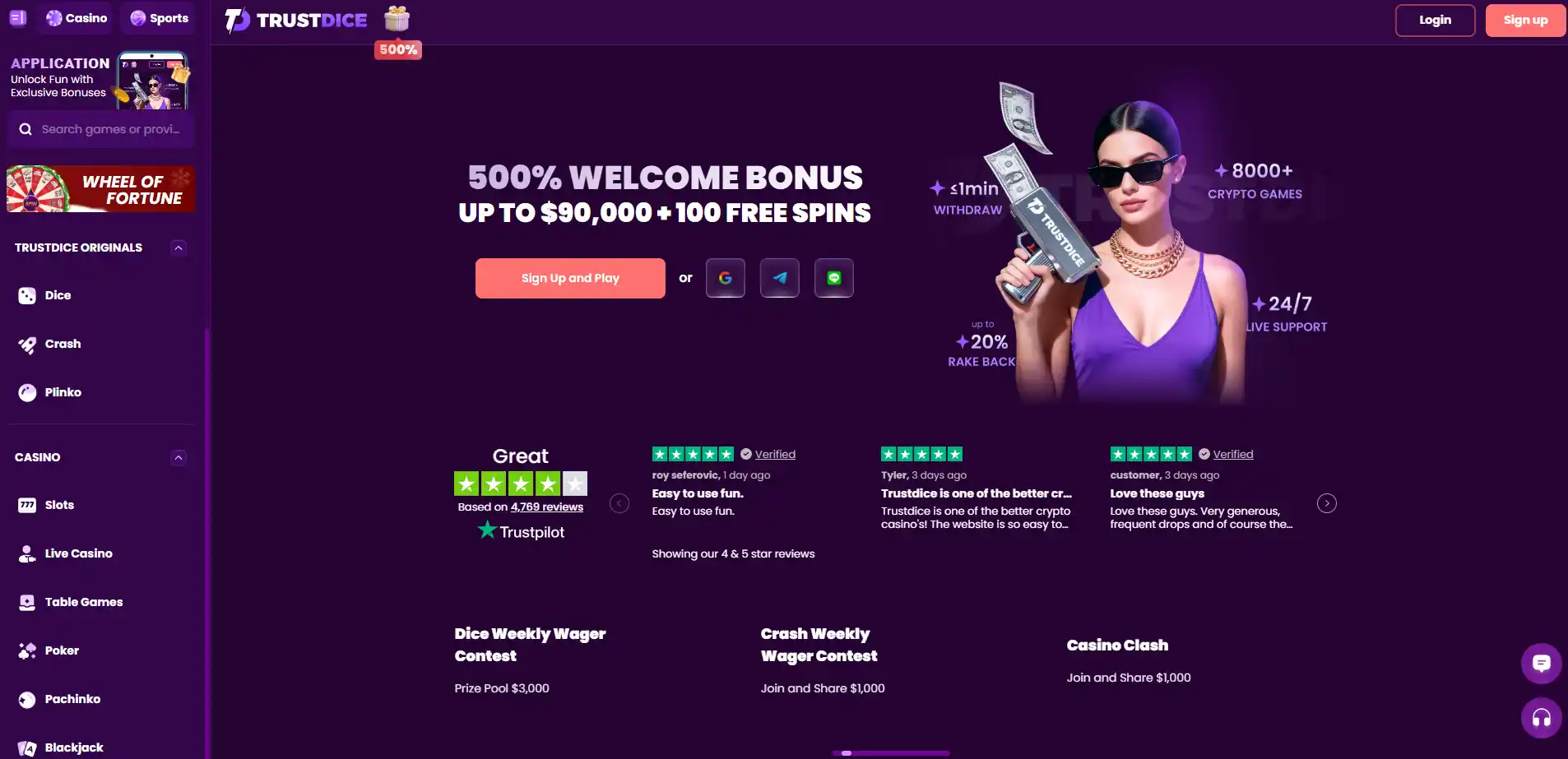
TrustDice’s welcome package spans the first three deposits and is presented with a total ceiling of up to 3 BTC. The specific tier percentages and free-spin counts have been described differently over time, so the cap is the stable reference point while the live offer terms are the place to check the current breakdown.
The primary wagering figure reported for the offer is 40×, with one account of a 35× requirement on a particular tier. A wagering multiple changes the scale of a bonus quickly. If a scenario produces a $100 bonus at 40×, the required turnover is $4,000. The amount you deposit is not the only number that matters; the bonus amount and wagering multiple determine how much betting volume the terms require.
The dedicated TrustDice bonus guide focuses on the package structure, expiry and the live-terms checks that matter before opting into any promotion.
| Term | TrustDice information | What it changes |
|---|---|---|
| Welcome scope | First three deposits | The package is spread across multiple deposit events rather than one single credit. |
| Total ceiling | Up to 3 BTC | The headline cap does not reveal the turnover required for a smaller personal deposit. |
| Working wagering figure | 40× | Each unit of bonus used in the scenario creates forty units of required turnover. |
| Offer duration | About 7 days | A time window can make a large turnover requirement more demanding in practice. |
A bonus should be reduced to three numbers before you judge its scale: the bonus amount actually credited, the wagering multiple, and the time allowed. Headline maximums alone do not describe the playthrough burden.
Wagering scenario checker
See how 40× wagering scales with your bonus
TrustDice’s welcome package is described as reaching up to 3 BTC across the first three deposits. This checker focuses on turnover rather than the headline cap: it uses 40× as the working wagering figure and lets you test your own deposit, match rate and illustrative RTP.
The 40× figure is the primary wagering requirement used for this scenario. Bonus tiers have not always been described identically, so check the current terms for the specific offer before relying on the result.
Scenario output
Scenario bonus
$100.00
Required turnover
$4,000.00
Theoretical playthrough cost
$160.00
Turnover-to-deposit ratio
40.0×
Substantial turnover exposure. At this scenario size, required wagering is 40.0 times the deposit before the RTP-based theoretical cost is considered.
How this works
Scenario bonus = deposit × match percentage. Required turnover = scenario bonus × 40. Theoretical playthrough cost = required turnover × (1 − illustrative RTP). The turnover-to-deposit ratio divides required turnover by the deposit amount.
The cost figure is a mathematical expectation over repeated play, not a prediction of what one session will lose. Short runs can finish far above or below that figure because gambling outcomes vary.
18+. Gambling Therapy offers international support. Check your local helpline and gambling laws in your own country. Crypto values can move sharply, and blockchain transactions are generally irreversible.
TXT, faucet and VIP rewards form a separate layer around casino play
TrustDice uses TXT, an EOS-based native token, as part of its reward economy. TXT can be mined through play and staked for daily dividends paid in BTC, ETH, EOS, USDT and USDC. That mechanism is distinct from the welcome package: it connects ongoing play and token holding to the platform’s reward distribution rather than to a one-time deposit match.
The casino also has a faucet that lets registered players claim small crypto amounts without a deposit. Published intervals differ, so it is more accurate to describe claims as available every few hours, with higher VIP status making the faucet more frequent. The VIP system adds rakeback/cashback mechanics, but the number of levels and exact percentages are not consistent enough to freeze into one chart.
This separation matters because a bonus, rakeback, faucet claim and TXT dividend are not interchangeable. Each has its own conditions and should be evaluated on those conditions rather than rolled into one implied return. The TrustDice VIP and TXT guide maps those mechanics without treating the token as an investment product.
TXT
TrustDice native token on EOS, mined through play.
TXT staking
Described as paying daily dividends in BTC, ETH, EOS, USDT and USDC from platform profit.
Faucet
Small crypto claims for registered players, available every few hours and more frequently at higher VIP status.
VIP
Includes rakeback/cashback mechanics; exact level counts and percentages vary across published descriptions.
Independent trust signals are broadly positive, with complaints still worth reading closely
Three external signals provide useful context without combining them into a new house rating. Trustpilot shows a 4.1/5 TrustScore from about 4,761 reviews. Casino Guru lists an 8.0 Safety Index, while AskGamblers lists an 8.4/10 expert score and 8.9/10 player score from about 608 reviews. Those numbers describe different systems, so they should not be averaged into a synthetic score.
| Source | Published signal | How to read it |
|---|---|---|
| Trustpilot | 4.1/5 from about 4,761 reviews | Large review volume gives a broad view of customer sentiment, including a visible minority of one-star reviews. |
| Casino Guru | Safety Index 8.0 | Its assessment did not flag unfair or predatory terms and described the complaint ratio as good relative to casino size. |
| AskGamblers | Expert 8.4/10; Player 8.9/10 from about 608 reviews | The record adds context from a casino-focused complaint and review platform. |
Complaint history should still be read, especially when a withdrawal is large. Complaint records on AskGamblers and Casino Guru include a minority pattern in which major wins were followed by holds or account action tied to allegations such as multiple accounts or unacceptable behavior; some disputes were resolved after escalation. This is not a basis for assuming every withdrawal will encounter trouble, but it is a practical reason to keep account activity clean and retain transaction records.
Third-party scores are context, not a guarantee of how a specific withdrawal, verification check or dispute will end. The most useful signals are the combination of review volume, complaint handling and the actual terms that apply to your account.
Account access can begin without upfront verification, but withdrawals may trigger checks
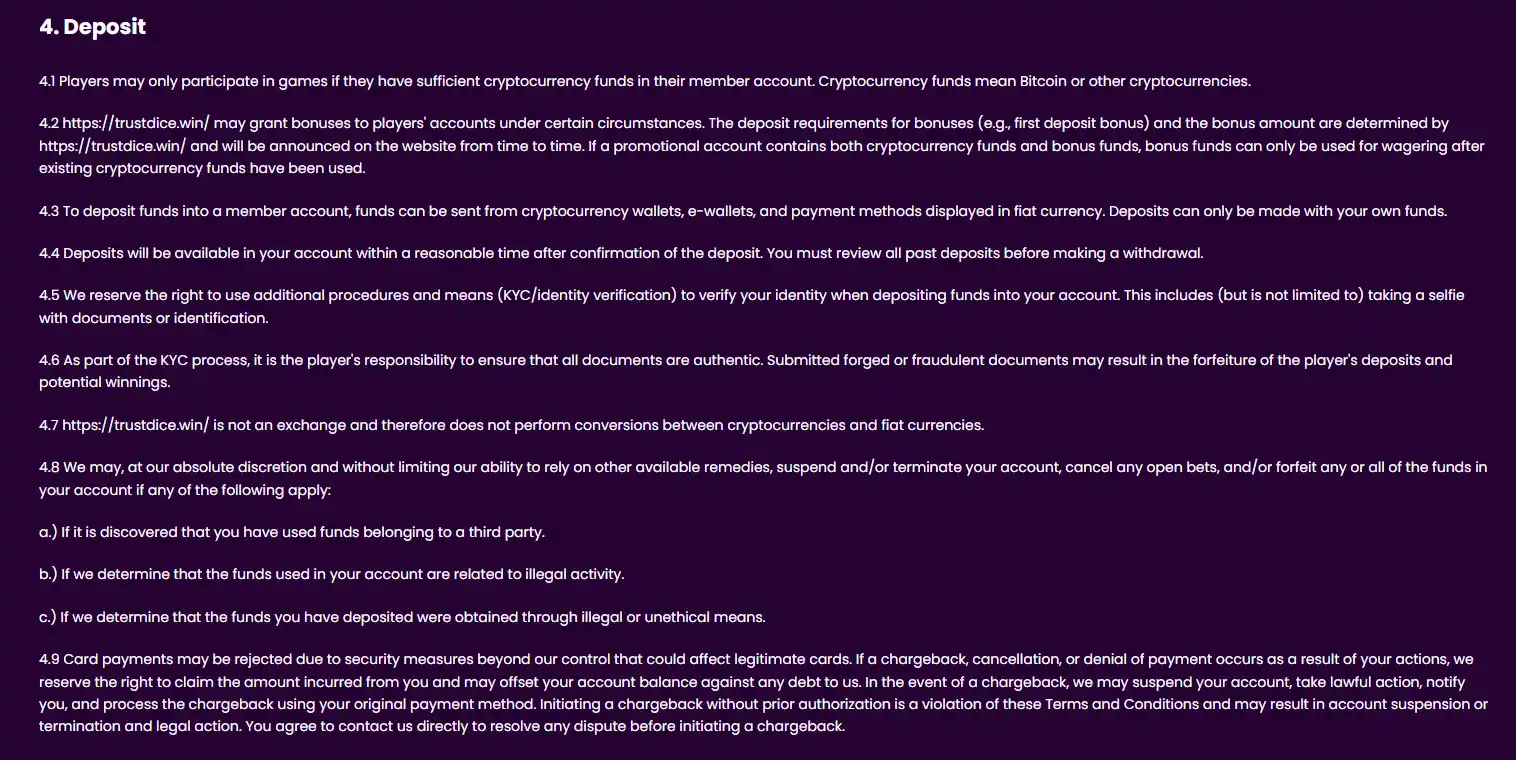
Independent coverage describes TrustDice as allowing account start without mandatory identity verification upfront. That should not be read as a promise of permanent anonymity. ID or address checks can be requested at withdrawal or when risk or amount thresholds are reached, and the exact threshold is not consistent enough to state as one fixed number.
The practical approach is to assume that a cashout can become a verification event even if registration was lightweight. If you want to understand that flow before depositing, the TrustDice account and KYC guide explains how the start-to-withdrawal sequence can change.
Mobile access is browser-based on iOS and Android, so the same account workflow can be used from a phone without relying on a store-installed app. On a mobile device, the most error-prone step is often not account access but copying addresses and choosing networks, which makes double-checking payment details particularly important.
- Create the account and secure access credentials before funding it.
- Use the payment dialog to choose the asset and matching network.
- Keep a record of deposits, withdrawals and any bonus terms attached to the balance.
- Expect that identity checks can appear when a withdrawal or account review reaches a trigger.
A few checks remove most avoidable crypto-casino friction
TrustDice gives experienced crypto users several useful tools, but those tools also create more decisions than a card-only casino. A short routine before depositing helps separate platform features from preventable wallet, wagering and account mistakes.
- Match the wallet network to the receiving network shown in the payment dialog.
- Read the live minimum for the selected asset instead of carrying over a threshold from another coin.
- For a welcome offer, calculate turnover from the bonus actually credited rather than from the headline package ceiling.
- Use provably fair verification to test the result mechanism, not as evidence that a game has positive expected value.
- Keep transaction records and be prepared for an identity review at withdrawal.
- Treat TXT, rakeback and faucet rewards as separate mechanics with separate conditions.
For broader payment detail, start with the coin and network guide; for game structure, use the catalogue and fairness guide. Those two sections address the areas where crypto-specific decisions have the most direct effect on everyday use.
Read next
- TrustDice payments and networks
- TrustDice games and providers
- TrustDice bonus and wagering
- TrustDice license details
Questions readers usually ask about TrustDice
Which cryptocurrencies does TrustDice support?
TrustDice supports BTC, ETH, TRX, EOS, BNB, XRP, USDT, USDC, LTC and DOGE. It operates across several blockchain rails, so the network shown in the payment dialog should match the network used by your wallet.
How does the 40× wagering figure work?
Using 40× as the working figure, required turnover equals the bonus amount multiplied by 40. A $100 scenario bonus therefore creates $4,000 of turnover. Current offer terms should be checked because historical tier descriptions have not always been identical.
Can TrustDice originals be checked on-chain?
Yes. TrustDice’s native provably fair system is described as making each roll or spin in its originals verifiable on-chain. That checks the result mechanism; it does not prove a positive expected return or supply an audited RTP.
Does TrustDice charge a withdrawal fee?
TrustDice does not add its own withdrawal fee. The blockchain network fee still applies, so the total transfer cost depends on the asset and network used.
TrustDice is strongest when its crypto mechanics matter to you
TrustDice combines ten listed crypto assets, multi-chain payments, thousands of third-party games, live tables and a set of native originals with on-chain verification. Its reward system goes further than a standard deposit bonus through TXT, faucet claims and VIP/rakeback mechanics. The trade-off is complexity: network selection, bonus turnover, later account checks and several overlapping reward systems all need to be understood separately.
The independent trust picture is broadly positive, while complaint records show why large cashouts still deserve careful documentation. The casino makes the most sense for a reader who will actually use its crypto-specific features rather than treating them as decoration. Whatever the feature set, gambling remains high-variance entertainment rather than a way to earn predictable returns.
Created by the ”TrustDice” editorial team.